

The Cold War Legacy of Michigan’s Nike Missile Sites

Updated: Jul 23
Detroit’s Strategic Rationale for Nike Missile Defense

Protecting a Vital Industrial Hub
Detroit was chosen as a major hub for Nike air-defense missiles because of its immense industrial and strategic importance. In the 1950s, Detroit was known as the “Arsenal of Democracy,” home to automobile manufacturing and wartime production facilities that would have been prime targets in a Soviet attack. Placing anti-aircraft missile sites around Detroit promised to shield these vital factories and the region’s dense population from nuclear-armed bombers. Military planners feared that in a surprise attack, Soviet long-range bombers might strike Detroit’s steel mills, auto plants, and infrastructure to cripple U.S. industrial capacity. By establishing a defensive ring of Nike batteries, the U.S. hoped to intercept and destroy enemy aircraft before they could reach the city.
Geographic Position and Bomber Routes
Michigan’s location made it a logical line of defense in continental air defense plans. Detroit lies in the northern United States, relatively close to the USSR via the polar route. As one historian noted, “The shortest route between Russia and the United States is over the North Pole across Canada into the northern states.” Enemy bombers attacking U.S. industrial centers would likely approach from the north, making Michigan one of the first states they would overfly. Thus, Detroit’s Nike missiles were not only guarding local assets but also serving as a forward shield for the broader Great Lakes and Midwest region. By 1958, a total of 16 Nike missile batteries encircled Metro Detroit in a “ring” formation, designed for overlapping coverage of the sky.
Cold War Urgency
The establishment of Nike bases in Michigan (and across the country) was driven by Cold War urgency. The outbreak of the Korean War and the Soviets’ first nuclear tests heightened U.S. fears of aerial attack. In 1954, the first Nike missiles were deployed around American cities as part of a rapid expansion of continental air defenses. Detroit’s first Nike sites became operational by 1955, reflecting the priority given to defending key industrial cities.
Nike Ajax and Nike Hercules: Missile Types and Capabilities

Nike Ajax – The First Generation
The Nike Ajax was the first U.S. guided surface-to-air missile to become operational. It had an effective range of about 25–30 miles and could reach altitudes around 60–70,000 feet. Guided by a ground-based radar and computer system, a Nike Ajax would be launched nearly vertically and then steered into the path of an incoming aircraft, detonating near the target to destroy it with shrapnel. Dozens of Nike Ajax missiles were deployed around Detroit by 1955, each site typically hosting a stockpile of 20–30 missiles kept ready on rails or in small underground magazines.
Nike Hercules – The Upgrade
The Nike Hercules was a larger, more powerful missile with an extended range of 75–100 miles and the ability to reach altitudes over 100,000 feet. Notably, the Hercules could carry either a conventional high-explosive warhead or a nuclear warhead (yielding up to around 20 kilotons). It also flew faster than the Ajax and had improved targeting electronics. Starting in 1958, Detroit’s Nike batteries began converting to the Hercules system, and by 1960, most had transitioned. Importantly, while the Hercules brought nuclear capability to local air defense, no actual nuclear warheads were ever stored on Detroit’s Nike missiles during the Cold War.
Number and Locations of Michigan Nike Sites

Detroit Defense Area
During the peak years of the Nike program, Michigan hosted a total of 16 Nike missile sites, all of them situated in a broad ring around Metro Detroit. This concentration was officially known as the Detroit Defense Area. Headquarters for Detroit’s Nike network were established at Selfridge Air Force Base and the Detroit Artillery Armory.
Geographic Spread
Sites included locations in Utica (D-06), Selfridge AFB (D-14/16), Algonac/Marine City (D-17), Belle Isle (D-26), Grosse Ile NAS (D-51), Riverview (D-54), Newport/Carleton (D-57/58), Wayne/Metro Airport (D-61), River Rouge Park (D-69), and Commerce Township/Union Lake (D-87). The sites were strategically positioned to provide overlapping fields of fire.
Structure and Operations of Nike Missile Installations
Each Nike installation was composed of an Integrated Fire Control (IFC) area with radar towers and command trailers, and a launch area where missiles were kept either on rails or in underground magazines. Missiles were tracked and guided by radar systems and detonated near their targets by remote command. Hercules-equipped sites often had three underground missile storage magazines with elevators to raise the missiles to surface-level launchers.
Northeast view interior, air traffic control and landing system
Building No. 1050 is a blast proof and electromagnetic-shielded structure that served as the command node of the North American Air Defense Command (NORAD) regional launch and interceptor center protecting the Great Lakes area.
Army and Local Personnel at the Missile Bases
Initially manned by regular U.S. Army air defense units like the 3rd Battalion, 55th Artillery, many of Michigan’s Nike batteries were later operated by the Michigan Army National Guard (177th AAA Battalion). A typical site had around 100 personnel divided among launch crews, radar operators, maintenance, and command staff.
Deactivation of the Nike Sites
Sites equipped only with Nike Ajax were shut down by the early 1960s, and by the early 1970s, all remaining Nike Hercules batteries in Michigan were decommissioned. The final sites, including Utica (D-06), Carleton/Newport (D-58), and Commerce Township (D-87), were closed in 1974. Factors included the rising threat of ICBMs, arms control agreements like SALT I and the ABM Treaty, and shifts in defense strategy.
Current Status and Remnants of the Nike Sites
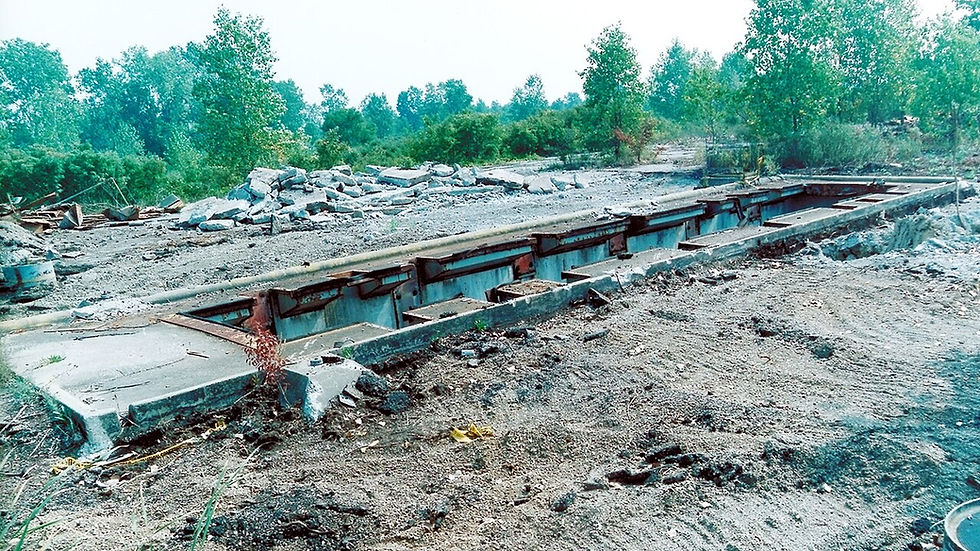
Today, many Nike sites in Michigan have been converted into parks or repurposed. Young Patriots Park in Riverview features a Nike Hercules missile on display with a commemorative plaque. The former sites at Belle Isle, Selfridge, and others have been turned into recreational areas, nature preserves, or demolished and redeveloped. In some locations, remnants of bunkers, radar towers, or control buildings can still be found.
Cold War Context and Public Awareness
Public awareness of the Nike missile sites varied. Some were visible and known in the community, such as the weekly drills at Rouge Park. While some residents took comfort in their presence, others were wary of their proximity. Local governments sometimes declined lease renewals, reflecting a mix of support and skepticism. Interest in this Cold War chapter has revived in recent decades through museums, local history groups, and historical preservation efforts.
Sources:
[1] ClickOnDetroit WDIV News (2022)
[2] App, Austin. Military History of the Upper Great Lakes (2017)
[3] Hermes, Grant. Metro Detroit’s Cold War Nuclear Missile Defense (2022)
[4] Nike Historical Society (site data and veteran accounts)
[5] Historic American Engineering Record (HAER No. MI-80), U.S. Army Corps of Engineers (1994)
[6] Wikipedia – List of Nike Missile Sites: Detroit Defense Area (2023)
[7] Friends of Rouge Park History Blog; Wayne County Gov. Historical Marker Archive (2025)


Comments